

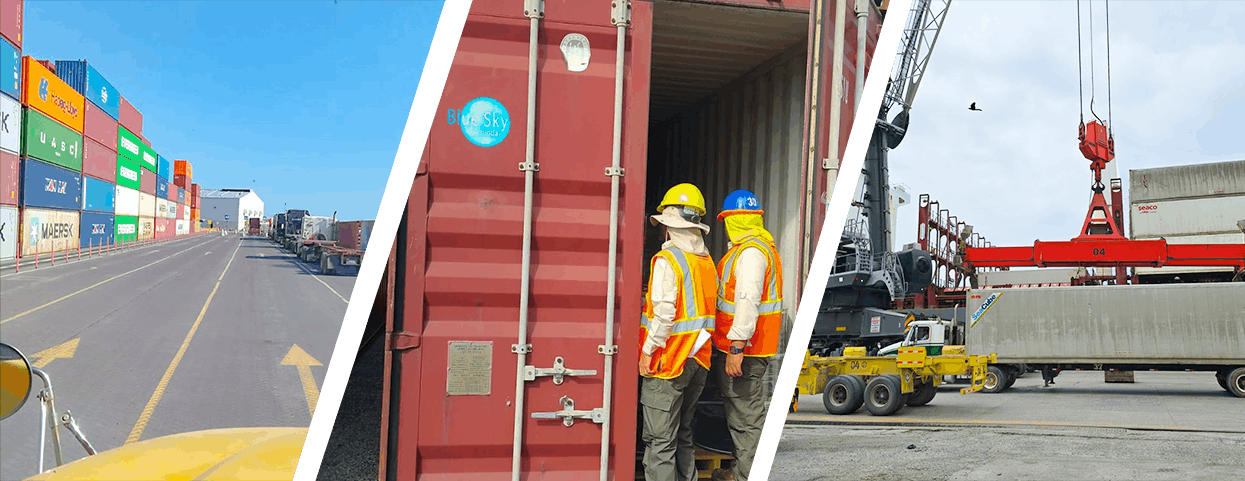
Importing for a business is not simply a matter of purchasing a product in another country and transporting it to Guatemala. Making the wrong decision regarding a supplier, documentation, container type, logistics costs, or customs procedures can result in unexpected costs, delays, and penalties.
For this reason, every import operation should be analyzed from a comprehensive perspective:
Product + Supplier + Documentation + Transportation + Customs + Costs + Delivery Times
In this guide, SAL Logistics covers the main aspects you should consider when planning an import into Guatemala.
The Superintendency of Tax Administration (SAT) establishes that any individual or legal entity wishing to import goods for commercial purposes must be registered in the Importer Registry and meet the following requirements:
Have a Tax Identification Number (NIT).
Have a registered and active business establishment in the Digital RTU.
Be registered under a Value Added Tax (VAT) regime.
Keep the Digital RTU information up to date and register the addresses associated with the storage of imported goods.
Have no outstanding tax compliance issues.
Have the representation of an authorized customs broker.
Obtain any permits or authorizations required according to the type of product being imported.
The documentation required may vary depending on the type of merchandise. However, the main documents generally include:
Commercial Invoice issued by the supplier, including the product description, values, currency, Incoterm, and importer information.
Packing List detailing packages, quantities, weights, and volume.
Customs Declaration.
Non-tariff permits, licenses, registrations, or certificates when required for the specific product.
Proof of payment.
Technical data sheet indicating the brand, characteristics, and model of the product.
Transport document, such as an Air Waybill (AWB) and/or Ocean Bill of Lading (B/L).
Tariff classification is the process of assigning a specific code to a product in order to identify it within the tariff system used in international trade.
Knowing the correct tariff classification of your product is essential to accurately estimate import taxes and determine the total cost of your import operation.
Determining applicable duties:
The tariff classification establishes the applicable percentage of customs duties you must pay when importing or exporting goods.
It also helps determine whether the product requires special permits, licenses, or health and safety certificates.
Imported goods are generally subject to 12% Value Added Tax (VAT), calculated on the CIF value (Cost + Insurance + International Freight) plus the applicable DAI (Import Duty).
The DAI rate varies according to the tariff classification of the product and may range from 0% to 15%.
Important: The applicable taxes and requirements may vary depending on the product and its tariff classification.
The true cost of an import goes beyond the purchase price of the merchandise.
It is important to consider all costs involved from the country of origin to the final destination in Guatemala, including transportation, insurance, customs duties, taxes, customs clearance, handling, and other logistics-related expenses.
Understanding these costs in advance allows you to calculate your actual landed cost, establish accurate sales prices, and avoid unexpected expenses.
Choosing the right container is one of the most important decisions when importing goods. The type and size of the container can directly affect freight costs, cargo safety, and the efficiency of the entire logistics operation.
For importers in Guatemala, understanding the main container options available makes it easier to plan each shipment and avoid unnecessary costs.
Not all cargo has the same requirements. Depending on the merchandise, a shipment may require additional space, ventilation, temperature control, special loading methods, or greater volume capacity.
Selecting the appropriate container helps ensure that your cargo is transported safely and efficiently.
Capacity: 20–33 m³
Maximum cargo capacity: approximately 26 metric tons
Ideal for small to medium-sized shipments, palletized goods, and dry cargo that does not require a large volume of space.
Capacity: 40–67 m³
Maximum cargo capacity: approximately 26 metric tons
Ideal for higher-volume shipments, machinery, spare parts, and general dry cargo.
Capacity: approximately 76 m³
Maximum cargo capacity: approximately 26 metric tons
Ideal for voluminous cargo requiring additional vertical space.
Designed to transport cargo that requires constant temperature control throughout the journey.
Temperature range: approximately -25°C to +25°C
Main uses:
Perishable goods, food products, flowers, and other temperature-sensitive cargo.
An Open Top container does not have a rigid roof and is designed for heavy, oversized, or irregularly shaped cargo that cannot be loaded through the doors of a conventional container.
Its design also allows tall cargo to be loaded from above using cranes.
Main use:
Heavy or oversized cargo requiring additional vertical clearance.
A Flat Rack is a platform with or without side walls, designed to transport cargo with irregular dimensions, complex shapes, or excessive weight that cannot fit inside standard 20- or 40-foot containers.
Main uses:
Industrial equipment, pipes, machinery, and large structures.
A Platform is a container platform without a roof or side walls. It is designed for cargo that cannot be transported inside enclosed containers and provides maximum flexibility for securing goods with unusual dimensions.
Main uses:
Machinery and oversized or project cargo.
The appropriate container will depend on the volume, weight, dimensions, type of cargo, and any special transportation requirements.
Choosing correctly can help you optimize freight costs, protect your cargo, and improve the efficiency of your entire import operation.
Incoterms define important responsibilities between buyers and sellers in international trade, including who assumes the costs, who arranges transportation, where delivery takes place, and when the risk associated with the goods transfers from the seller to the buyer.
Understanding Incoterms is essential when negotiating with international suppliers and can help avoid misunderstandings and unexpected costs.
| Group | Incoterms | Description |
|---|---|---|
| E | EXW | The buyer assumes virtually the entire operation from the seller’s premises. |
| F | FCA, FAS, FOB | The seller delivers the goods to the carrier or at the agreed point, while the buyer assumes responsibility for the main transportation. |
| C | CPT, CIP, CFR, CIF | The seller arranges and pays for the main transportation, but the risk transfers to the buyer before the goods reach their final destination. |
| D | DAP, DPU, DDP | The seller assumes most of the responsibilities and costs until the agreed destination. |
Choosing the right Incoterm can have a significant impact on the total cost, responsibilities, and risks associated with your import operation.
All goods entering Guatemala are subject to 12% VAT, calculated on the CIF value (Cost + Insurance + International Freight) plus the applicable Import Duty (DAI).
The DAI (Derecho Arancelario a la Importación), or Import Tariff Duty, varies according to the product’s tariff classification under the Central American Tariff System (SAC) and can range from 0% to 15%.
| Product | Approx. DAI | VAT |
|---|---|---|
| Medicines and Medical Supplies *Subject to permits | 0% | 12% |
| Industrial Machinery and Raw Materials | 0%–5% | 12% |
| Electronics and Technology (laptops, components, and mobile phones) | 0%–5% | 12% |
| Automotive Spare Parts | 5%–10% | 12% |
| Furniture and Home Appliances | 15% | 12% |
| Clothing, Footwear, and Textiles | 15% | 12% |
| Toys and Sporting Goods | 15% | 12% |
| Processed Food Products | 15% | 12% |
The table above provides a general reference range based on the structure of the Central American Tariff System (SAC), which generally applies DAI rates of 0%, 5%, 10%, or 15%.
The exact rate depends on the product’s specific tariff classification. Medicines and certain medical supplies may require special permits or authorizations for importation.
The calculation is based on the CIF value (Cost + Insurance + International Freight):
CIF VALUE = Cost of goods + Insurance + International Freight
DAI = CIF Value × Applicable Tariff Rate
VAT = (CIF Value + DAI) × 12%
TOTAL TAXES = DAI + VAT
The CIF value is the basis used to calculate import taxes. It consists of the:
Cost of the goods + Insurance + International Freight.
International transportation is a key part of every import operation.
Learn about the main ocean and air freight alternatives and when each option may be the most appropriate for your cargo.
At SAL Logistics, we understand that every operation is different. For a business, time, cost, and reliability throughout the supply chain directly impact its results.
That is why we develop transportation solutions tailored to your specific needs, helping you select the most suitable option for your cargo, budget, and delivery requirements.
Contact SAL Logistics and let our team help you plan your next shipment to Guatemala.
Transforming Logistics into Results.